George Davis and Michael Clark


A Prologue

 A Word about the Kingdom


Over the last few decades, the abuse of authority in the modern-day church has resulted in a flood of books and articles on the subject. Most of these well-meaning authors unwittingly cast kingdom authority in a context that Jesus strictly forbade. They vainly tried to harmonize the life and teachings of the Servant Christ with the illicit top-down authority paradigm of the kings of the Gentiles (Luke 22:25). This is a certain recipe for failure and abuse. How so? Abuse issues from a basic misunderstanding of the kingdom of God. When we hear the word kingdom, images of courts and castles, kings and lords, royal guards and armies flood our minds. We automatically think of something outwardly pompous and powerful.

But God had something else in mind--a kingdom of the heart for the pure in heart. When asked by the Pharisees when the kingdom of God would come, Jesus answered, "The kingdom of God does not come with observation; nor will they say, 'See here!' or 'See there!' For indeed, the kingdom of God is within you" (Luke 17:21). The kingdom of God is not detectable by the carnal senses. It does not come with outward display of the world's wealth and success. You cannot say of His kingdom, "See here!" or "See there!" It exists within the hearts of those in whom the King himself has taken up residence and rule. The same thing is true of kingdom authority. It also operates quietly and powerfully within the sphere of the inward governance of God.

Regardless of the profound truth stated by Jesus, men strive incessantly to build observable kingdoms in His name, with outwardly observable authority structures and palatial buildings where their authority cannot be questioned. They try to mix the authority paradigm of the kingdoms of this world, which are under the influence of the prince of this world, with that of the kingdom of God. This always leads to fighting and abuse.
 

In answer to Pilate's question "Are you the king of the Jews?" Jesus said, "My kingdom is not of this world. If my kingdom were of this world, then my servants would fight, that I wouldn't be delivered to the Jews. But now my kingdom is not from here" (John 18:36 WEB). Abuse and fighting are prevalent wherever this unholy mixture exists. No matter how outwardly holy it may look, if its origin is not heavenly it will express the nature of the world, fighting and lording over. If we embrace the world's form we must also use the world's power to enforce it, i.e., brute force. Where there is force you will also find resistance. Force and resistance equals fighting. If the kingdom of God has not come within us and quelled our inward lust that wars in our members, that inward condition will continue to express itself and the fighting will persist tearing up one fellowship after another. "From where do wars and fightings among you come? Is it not from this, from your lusts warring in your members?" (James 4:1 LITV). "Our wars," said Erasmus, "for the most part, proceed either from ambition, from anger and malice, from the mere wantonness of unbridled power, or from some other mental distemper."


When the guards of the temple and the high priest came to arrest Jesus, Peter, still operating in the paradigm of the kingdoms of this world, did what servants of the world's kingdoms do. He took out his sword and cut off a soldier's ear. Historically, great bloodshed has resulted because of this gross misunderstanding of God's kingdom. One historian wrote, "I saw in the whole Christian world a license of fighting at which even barbarous nations might blush" (Hugo Grotius – Prolegomena). Least we think that today's more enlightened Christians are above such barbarity, we should point out that recently one TV Evangelist proposed that the CIA assassinate the president of Venezuela because of his Marxist leanings. Peter, put away your sword! You know not what spirit you are of!

So, what is the answer to this kingdom confusion we see more and more in Christendom today? As simplistic as this might sound, Jesus is the answer. He is our example. Jesus came to show mankind the way back to that selfless dominion that Adam exercised before the fall. How did He do this? Though He was equal with God, Jesus emptied Himself, made Himself of no reputation and took a humble position at the bottom of the social scale. He modeled true kingdom greatness by denying what men so eagerly grasp for (worldly wealth and power) and taking on a form that ambitious men despise, that of a servant. From there He obediently humbled Himself even further by dying a criminal's death on a Roman cross, not for His own misdeeds but for the sins and sorrows of a world set on destroying Him. For this reason, God exalted Him and gave him complete authority, i.e., the name that is above every other name (Philippians 2:6-11). Anyone who would be great in the kingdom of God must follow this same path.

And so the question remains; who has the authority? This very issue is at the heart of all conflict in the world and in the Church. Who has the right to be in control?


After His resurrection Jesus said to His disciples, "I have been given complete authority in heaven and on earth. Therefore, go . . ." (Matthew 28:18-20 NLT). Many today act as though Jesus said, "I have been given complete authority in heaven and on earth. Therefore go and impose it on everyone . . . use force if necessary!" Though men today boldly profess that their churches are founded upon Christ and His teachings, their churches more resemble Augustine's assessment of the city and Church of Rome, "which. . .is itself ruled by its lust of rule." (Augustine --City of God, Introduction).


When Jesus sent out His disciples into the world He said, "Go your way; behold, I send you out as lambs among wolves" (Luke 10:3 NKJV). He did not send them forth as lions to conquer. When John had his heavenly vision of the throne of God in Revelation we read:


But one of the elders said to me, "Do not weep. Behold, the Lion of the tribe of Judah, the Root of David, has prevailed to open the scroll and to loose its seven seals." And I looked, and behold, in the midst of the throne and of the four living creatures, and in the midst of the elders, stood a Lamb as though it had been slain. . ." (Revelation 5:5-6a NKJV)


Jesus did not send us forth as conquering lions-- kings of the world's jungles. John was not even allowed to see Jesus in this light, but rather the Pattern Son appeared to the apostle as a lamb that had been slain. This is all he had to see in order to understand the power of the kingdom of God. Is Jesus a King? Yes, but a King that has conquered Satan by laying down His life for His friends. His servants conquer by living lives demonstrating nothing less--lambs among wolves.

How did we drift so far away from the example and teaching of the Lamb; the Lord Jesus Christ? To answer this question we must take a fresh look at Jesus' life and teachings, especially those passages having to do with authority. We think you might be surprised at what He really said! 


"I confer on you a kingdom"

 Luke 22:14-30 - John 13:1-17


We tend to characterize chapters and verses of the Bible by emphasis. We call Hebrews 11 the faith chapter and I Corinthians 13, the love chapter.  In our view, Luke 22 and John 13 should be called the "authority chapters," though those who teach authority today rarely refer to them. Instead they draw on the teachings of the old covenant. After you read these passages you might wonder what they have to do with authority. The reason we miss it here is that we are still viewing authority as the world views it. The word authority appears only once in these chapters and that in a negative sense. Nevertheless, the foundation of kingdom authority is established and demonstrated throughout. These chapters record the events in the upper room leading up to Jesus' proclamation to his disciples, "I confer on you a kingdom."  

Reason would argue that this must imply that certain ones in the Church are given authority to rule over the congregation. So goes the natural logic. But if Christ's kingdom is not of this world's paradigm, which serves as a model for virtually every mental construct of authority, what is His kingdom of, after or according to? What is the nature of the Kingdom that Jesus gave to the twelve? To understand this we must take Christ's words, "I confer on you a kingdom," in context. These words do not stand alone. Recounting the events leading up to this statement is crucial to our understanding of it. We must go to the upper room with Jesus and His disciples and watch the events that led to this proclamation. There we will discover that this kingdom edict was spoken in answer to an argument that erupted among the disciples while they reclined at table.

To get an expanded view of what took place there in the upper room, we will harmonize the accounts of Luke and John. It is important that you read them in their entirety to get perspective.

Luke begins:

When the hour had come, he sat down with the twelve apostles. He said to them, "I have earnestly desired to eat this Passover with you before I suffer, for I tell you, I will no longer by any means eat of it until it is fulfilled in the Kingdom of God." He received a cup, and when he had given thanks, he said, "Take this, and share it among yourselves, for I tell you, I will not drink at all again from the fruit of the vine, until the Kingdom of God comes." He took bread, and when he had given thanks, he broke it, and gave to them, saying, "This is my body which is given for you. Do this in memory of me." Likewise, he took the cup after supper, saying, "This cup is the new covenant in my blood, which is poured out for you. But behold, the hand of him who betrays me is with me on the table. The Son of Man indeed goes, as it has been determined, but woe to that man through whom he is betrayed!" They began to question among themselves, which of them it was who would do this thing. There arose also a contention among them, which of them was considered to be greatest.

He said to them, "The kings of the Gentiles lord it over them, and those who have authority over them are called 'benefactors.' But not so with you. But one who is the greater among you, let him become as the younger, and one who is governing, as one who serves. For who is greater, one who sits at the table, or one who serves? Isn't it he who sits at the table? But I am in the midst of you as one who serves. But you are those who have continued with me in my trials. I confer on you a kingdom, even as my Father conferred on me, that you may eat and drink at my table in my kingdom. You will sit on thrones, judging the twelve tribes of Israel" (Luke 22:14-30 WEB).

It is important to note that many believe that the gospel of John, which was written much later than the others, was written to include things that were left out of the other gospel narratives. Filling in the gaps, John wrote:

Now before the feast of the Passover, Jesus knowing that his time had come that he would depart from this world to the Father, having loved his own who were in the world, he loved them to the end.

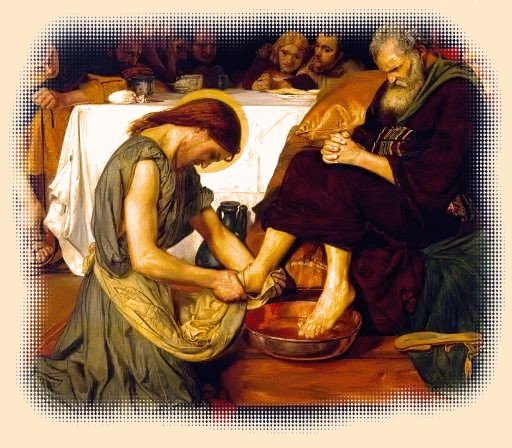
After supper, the devil having already put into the heart of Judas Iscariot, Simon's son, to betray him, Jesus, knowing that the Father had given all things into his hands, and that he came forth from God, and was going to God, arose from supper, and laid aside his outer garments. He took a towel, and wrapped a towel around his waist. Then he poured water into the basin, and began to wash the disciples' feet, and to wipe them with the towel that was wrapped around him. Then he came to Simon Peter. He said to him, "Lord, do you wash my feet?" Jesus answered him, "You don't know what I am doing now, but you will understand later." Peter said to him, "You will never wash my feet!" Jesus answered him, "If I don't wash you, you have no part with me." Simon Peter said to him, "Lord, not my feet only, but also my hands and my head!" Jesus said to him, "Someone who has bathed only needs to have his feet washed, but is completely clean. You are clean, but not all of you." For he knew him who would betray him, therefore he said, "You are not all clean." So when he had washed their feet, put his outer garment back on, and sat down again, he said to them, "Do you know what I have done to you? You call me, 'Teacher' and 'Lord.' You say so correctly, for so I am. If I then, the Lord and the Teacher, have washed your feet, you also ought to wash one another's feet. For I have given you an example, that you also should do as I have done to you. Most assuredly I tell you, a servant is not greater than his lord, neither one who is sent greater than he who sent him. If you know these things, blessed are you if you do them." (John 13:1-17 WEB)

Let's consider what we've just read. Christ's eagerness to share this meal with His disciples, evident in both these passages, is very significant. This is something He had looked forward to, with strong desire, for a long time, which implies that this event was previously planned in eternity. The Greek word used by Luke to describe the intensity of Christ's longing, was translated lust 31 times and concupiscence three times by the King James translators. This gives us a sense of the intensity behind Christ's words: "With desire I have desired to eat this Passover with you. . .." Undoubtedly this particular meal was planned by heaven to teach something that Jesus greatly desired His disciples to understand.

In John 13:1, we find further indication of this. ". . .having loved his own who were in the world, he loved them to the end" (Greek telos). What does this mean? Certainly this was not the end. The necessary redemptive work of the cross had not been accomplished yet. The Lamb of God had not been slain yet. The emancipation proclamation, "It is finished" had not been pronounced from the cross. What could this mean then, ". . .He loved them to the end"?

The answer is found in the definition of the Greek word telos. W.E. Vine explains, "Telos signifies. . . the final issue or result of a state or process . . . the utmost degree of an act. . ." Telos is the end result and ultimate expression of a thing. Jesus earnestly desired to teach His disciples the end all things relate to. This would be His final and crowning act of service before the time of His suffering. He loved them to the end, to the utmost degree and in doing so redefined, for all generations, the Kingdom and its authority. In that upper room, Jesus set on display the kingdom He was about to bestow upon His disciples. To fully understand that kingdom, we must first comprehend the kingdom that the Father conferred on Christ, for Jesus said, "I confer on you a kingdom, even as (or just like) my Father conferred on me. . ." So what did the King of God's kingdom do in their presence? He took on the form of a servant and washed their feet. Jesus was demonstrating the nature of His eternal kingdom to them. Let's continue with this kingdom in mind.

This Paschal Supper began in the usual way; by the Head of the company taking the cup, and speaking over it. The application that Jesus made was unheard of. He taught that the wine and the bread of this long held traditional meal represented His Body and blood, soon to be broken and shed for them. Amazingly, while He was speaking of this great mystery of humbly and obediently laying down His life for their sakes, an argument broke out among the disciples. They were quarrelling over who would be the greatest. They evidently didn't hear a word Jesus said. He shared the symbols of a life laid down while they argued over who deserved the chief seats in His eternal throne room.

Has anything really changed today? Though not openly, such an argument still rages among God's people. Such ambition still hinders humble service among God's people and, like a dark veil, hides the true meaning of the gospel of the kingdom of God from the world. How often is Jesus' sacrifice ignored or spoken against because of ecclesiastical jockeying for position and power? Jesus addressed this ambition in his disciples by telling them that they held the wrong paradigm of authority and that they would not rule, like the kings of the Gentiles, as they supposed, but instead the greatest among them would be exactly as He had been before their eyes, the servant of all. The servant is not greater than his Master.

Customarily, in the next part of this ceremonial meal, the Head of the house would rise and wash his hands in a show of piety. Evidently, Jesus viewed this as the perfect time to further demonstrate His point. He got up from the table to wash, but He stripped himself and wrapped Himself in a servant's towel. Things were deviating from the norm radically, and it was about to get stranger still. Jesus filled a basin with water and began to wash His disciple's feet. This was unheard of. The heads of households simply did not stoop to such menial tasks. The household servants did this job. What was Jesus doing? Was He deliberately trying to offend His disciples? No. He was demonstrating the kingdom the Father had given to Him. Peter's reaction likely reflected the view of all the disciples. He clearly didn't understand what Jesus was doing and openly voiced his disapproval. Peter might have readily submitted if Jesus had taken upon himself a kingly robe and insisted that others bow before Him in service to Him but this servant's towel and foot-washing -- no way! It put their thoughts of what the kingdom of God is in total disarray.

God forbid that Peter should enable such behavior! "You shall never wash my feet!" he exclaimed, perhaps uneasy with the thought of their Lord stooping to such an unbecoming task. He would have no part of it! He simply refused to take part in something so demeaning to the dignity and station of the Messiah and His kingdom. Everyone knew that Messiah would come as a conquering Lion and crush the Roman eagle, but He would never come bowing and washing feet like a common household slave! Christ's answer to Peter's stubborn refusal was even more perplexing.


"If I do not wash you, you have no part with me." Have you ever wondered why Jesus would say such a thing? Why would Peter's refusal to allow Jesus to wash his feet disqualify him? After all they had been through, was Peter now to be set aside for refusing to put his feet in the washbasin? Doesn't that seem a bit severe? No, not really.


When we consider that foot washing is representative of the very Spirit and purpose behind Christ's life and ministry we can better understand His insistence upon Peter's involvement. Furthermore, no one can have part with Jesus short of their fellowship and participation in the reality that the act of foot washing represents. Think of it! If He, by whom all things were created, humbled Himself and made Himself Servant of His creation, how should we mere creatures live? He took on the servant's towel. Dare we waste our lives posturing our way into elevated positions? Ponder this as we consider again Christ's words to Peter. "If I do not wash you, you have no part with me."


The Greek word for have in this passage is used of people joined by the bonds of natural blood, marriage or friendship. It denotes being closely joined to a person or thing. It speaks of the ground of union. The Greek word translated part is meros, which means a part due or assigned to one; a lot, or destiny. Jesus was saying, "If I do not wash your feet, you cannot be joined to me in companionship, or share in my purpose and destiny." Why? Peter would have been arrogantly going one way while Jesus was humbly going another. "What I am doing you do not understand," Jesus said, "but you will know after this."


Hidden within the example of Christ's humble service to His disciples was a mystery yet to be revealed, the requirement for usefulness in the Kingdom of God, the requirement for having part with Jesus and sharing in His kingdom and authority. What was it that the disciples would come to know? They would finally come to see authority as Christ saw it, not as something to be grasped but as something to be laid down or given and entrusted to God. They would come to see true greatness, not as the world defines it, but as God defines it. They would come to see that the great ones among them are servants, not figuratively or in word only but literally, and that the greatest are slaves. Herein is the ground of authority that we shall frequently return to throughout the remaining pages of this book.

Jesus offered the twelve a kingdom just like the one the Father had given Him. The part (meros) or destiny and the kingdom that He allotted them are undoubtedly one and the same. Jesus offered them a kingdom exactly like (kath-oce'), in proportion as, and in the degree that the Father had given Him. This kingdom was displayed as the King Himself knelt like a household slave, washing their feet, and not many days from then, this very King would follow this path of servanthood to the cross where he laid down His life for all. Jesus required everyone who would dare to follow Him to "deny himself, take up his cross and follow Me."  This most certainly applied to the twelve. While we do not deny that they will "sit on thrones judging the twelve tribes of Israel," we strongly assert that that was never intended to happen during their earthly sojourn. Nor will anything like it happen in ours, should we choose to follow Him. The earth is the proving-ground of servants, not the footstool of would-be kings. Only those who have overcome the wicked one by the blood of the Lamb and love not their lives unto death will rule and reign with the Son of God when Satan has been cast down once and for all.

Then I heard a loud voice saying in heaven, "Now salvation, and strength, and the kingdom of our God, and the power of His Christ have come, for the accuser of our brethren, who accused them before our God day and night, has been cast down. And they overcame him by the blood of the Lamb and by the word of their testimony, and they did not love their lives to the death.  (Revelation 12:10-11 NKJV)


Until that worm is cast down, he will find a way to manifest in those who rule on this earth, be they in the governments of men or those of the church.

What kind of kingdom did the apostles receive and participate in while here on earth? What part did they have with Jesus? Did they sit on thrones? No. Jesus didn't, nor did they. Did they receive honor, like earthly kings? No. Jesus didn't, nor did they. Did they wear kingly robes? No. Jesus didn't, nor did they. Did ever a kingly crown embrace their brow? No! Did they set up an earthly diocese to broaden the scope of their power and influence? No. Jesus refused to be an earthly king and so did they. Did they dwell in aristocratic castles, like the kings of this world? No. History tells us of their kingdom. Just like their Lord, their stay here on earth was not luxurious. Just like their Lord, their path was filled with suffering and death. Yes, they received a Kingdom exactly like His, a kingdom complete with the cross. Instead of ascending to rule, they followed Christ the King on a path leading downward, ever downward to the fellowship of His suffering, and ultimately to the cross, the grave and glorious resurrection life! In John 21:18-19, Jesus spoke of this kingdom to Peter. "'I tell you the truth, when you were younger you dressed yourself and went where you wanted; but when you are old you will stretch out your hands, and someone else will dress you and lead you where you do not want to go.' Jesus said this to indicate the kind of death with which Peter would glorify God." Church history tells us that when they were about to crucify Peter, he asked that they crucify himself upside down for he knew that he was not worthy to die as His Lord had died. Peter surely did drink of the cup of Christ and is worthy to be called a disciple. Are we? Will we deny ourselves and follow Him?

After Paul's conversion on the road to Damascus, the Lord said to Ananias regarding him, "For I will show him how many things he must suffer for my name's sake" (Act 9:16 WEB). Years later Paul wrote, "For I think that God has set forth us the apostles last, as it were appointed to death: for we are made a spectacle unto the world, and to angels, and to men" (1 Corinthians 4:9. See also 2 Corinthians 11:24-28, Philippians 3:10). What kind of Kingdom is this? What kind of kingdom is it where those who are foremost in calling and commission are set forth last--appointed to death? Only those who drink Christ's cup and are baptized with Christ's baptism can reign with Christ.

Paul wrote, "If we suffer, we shall also reign with him . . ." (2 Timothy 2:12). This suffering is initially an inner suffering that occurs when we side with Christ and turn against even our own fleshly ambition to promote ourselves and get all we can get in this life. This suffering becomes outward when we manifest the abiding Christ and take the form of a servant as he did and become obedient unto death. The world loves only those who achieve greatness at the top, where authority is measured by the right or power to give orders and enforce rules. Only those who, by the power of God, have overcome that dark ambition in their own hearts to rise and rule, and have laid down their lives in service, can have part with Christ and share in His authority.


The Cup, the Baptism and Kingdom Authority

Matthew 20: 17-23


Earlier, while going up to Jerusalem, Jesus took His disciples aside and said to them, "Behold, we go up to Jerusalem. And the Son of Man shall be betrayed to the chief priests and to the scribes, and they shall condemn Him to death. And they shall deliver Him to the nations to mock and to scourge and to crucify. And the third day He shall rise again."

Immediately after this, in the very next verse, the mother of James and John came to Jesus with her two sons, worshipping Him. Jesus said to her with piercing insight, "What do you want?" She replied, "Grant that these my two sons may sit, the one on your right hand, and the other on the left, in your kingdom." (How often have we "worshiped Jesus" to get something in return?) They really didn't get it! Had they not heard a single word Jesus had said? Jesus answered; "You know not what you ask. Are you able to drink of the cup that I shall drink of, and to be baptized with the baptism that I am baptized with?" James and John replied, "We are able." Jesus said to them, "You shall indeed drink of my cup, and be baptized with the baptism that I am baptized with. But to sit on my right hand, and on my left, is not mine to give, but it shall be given to them for whom it is prepared of my Father."

There is a due order in God's Kingdom . . . first the cup and the baptism . . . then the crown. It is not a crown that is immediately before us as we devoutly worship Him, it is the cross. It is not coronation but the cup--the fellowship of Christ's sufferings. Those who go after promotion in His kingdom don't know what they're asking for. If they knew about the cup and the baptism they might not be so eager. God set suffering between the disciple and the throne. "It is through many afflictions that we must make our way into the Kingdom of God" (Acts 14:22). If we suffer with Him we shall reign with Him. Jesus used this event to teach a kind of authority that the world had never seen before and that men still struggle to see today.


Servant Authority

Matthew 20:25-28


"You know that the rulers of the Gentiles lord it over them, and their great men exercise authority over them. It shall not be so among you; but whoever would be great among you must be your servant, and whoever would be first among you must be your slave; even as the Son of man came not to be served but to serve, and to give his life as a ransom for many." (Matthew 20:25-28, RSV).

Jesus started with what His disciples already knew. He began with the vertical hierarchical model of the Gentile kings. Throughout its four thousand-year history, the world had rarely known any other form of authority than that authority which is taken, grasped and enforced by clever arguments and enticements, and where that fails, the edge of the sword. Even Israel, who had God as their king, grieved Him by asking for a king like the Gentile nations around them. Jesus was about to correct that error. He was about to present a concept of authority and leadership that would literally turn this earthly model on its head.

"The rulers of the Gentiles lord it over them"

The Greek word for rulers is archon [758]. IN the KJV, this word  translated as ruler 22 times; prince 11 times; chief twice; magistrate and chief ruler one each. This is the word that gave us the English word arch, which means chief or principal, such as archbishop, arch-nemesis, and arch-enemy or arch-rival.

In Christ's day an archon was a ruler or commander in the world system. Archon is the present participle of archo [757], which means to rule over or reign over, emphasis being on over. Throughout the scriptures, archon is used of world rulers, of Satan, the prince of this world, and of Christ, but it is never used to describe believers. Below are the key passages in which archon is used, as compiled by W.E. Vine.

<archon> ". . . the present participle of the verb archo, "to rule;" denotes "a ruler, a prince." It is used as follows (denoting "prince," or "princes;" "ruler" or "rulers"): (a) of Christ, as "the Ruler (AV, Prince) of the kings of the earth," Rev 1:5; (b) of rulers of nations, Mat 20:25, RV,  AV,  Acts 4:26,  Acts 7:27,  Acts 7:35,  (twice); (c) of judges and magistrates, Acts 16:19,  Rom 13:3, (d) of members of the Sanhedrin, Luke 14:1, RV, (AV, "chief"); Luke 23:13, Luke 23:35, Luke 24:20; John 3:1; John 7:26, John 7:48; John 12:42, (RV, "rulers") (AV, "chief rulers."); in Acts 3:17; Acts 4:5, Acts 4:8; Acts 13:27; Acts 14:5; (e) of rulers of synagogues, Mat 9:18, Mat 9:23,  Luke 8:41; Luke 18:18; (f) of the Devil, as "prince" of this world, John 12:31; John 14:30; John 16:11; of the power of the air, Eph 2:2, "the air" being that sphere in which the inhabitants of the world live and which, through the rebellious and godless condition of humanity, constitutes the seat of his authority; (g) of Beelzebub, the "prince" of the demons, Mat 9:24; Mat 12:24; Mark 3:22; Luke 11:15. See CHIEF, B, No. 10."

Again, archon is never used in regard to the community of believers because there is only one archon of the Church, and that is Christ, the Ruler of the kings of the earth (Revelation 1:5). He alone is King of kings and Lord of lords. The conclusion is inescapable. There is only one rightful ruler in the body of Christ, the Head, Christ Jesus. We must therefore subtract all that is implied by the Greek word archon from our definition of authority as it relates to the members of Christ's body. There is only one Lord or Archon of the church. (Ephesians 4:50)

Archon was also used of rulers of synagogues (Matthew 9:18,23). We are convinced that this is one of the reasons that Jesus did not choose the synagogue as the model for the New Testament Church. Instead he chose the Greek ekklesia, which stood for freedom of speech and every-member-participation. Unlike the synagogue, the ekklesia was a purely non-religious gathering. What do the kings of the Gentiles do? By their very natures they ". . .lord it over (katakurieuo) them."

katakurieuo [2634] means, "To bring under one's power, to subject one's self, to subdue, master, to hold in subjection, to be master of, exercise lordship over" (Thayer's Lexicon)

Peter later revealed that he had indeed come to understand the mystery of foot-washing. He reminded the elders or senior members of the Church of the Lord's teaching on the evils of lording over God's heritage. "Neither as being lords (katakurieuo) over God's heritage, but being examples to the flock" (1 Peter 5:3). Paul wrote to the Corinthian believers, "Not that we lord it over your faith, but we work with you for your joy, because it is by faith you stand firm" (2 Corinthians 1:24 NIV). Note here that a true leader works with the believer in all joy, knowing that it is only by his own faith that a believer can stand, not by abject subjugation to the will of the leadership.


The objective here is standing. Paul is contrasting two ways that people are supposedly made to stand. One is purely humanistic and the other is divine. Religious man tries to cause people to stand--which means conform to his religious standard--by  propping them up through expectations, looking over their shoulders and making sure that everything is done up to their standards. So reads The Message Bible, "We're not in charge of how you live out the faith, looking over your shoulders, suspiciously critical. We're partners, working alongside you, joyfully expectant. I know that you stand by your own faith, not by ours (2 Corinthians 1:24 MSG).


In truth, the only way that people are enabled to stand is by personal faith and personal spiritual growth in God. We can be helpers (examples) or fellow-laborers but we cannot be lords over God's heritage. It is by their faith, not ours,  that each individual in Christ's body stands. The faith spoken of here is not adherence to articles of faith but that faith that brings one into a living  and viable relationship with God, so close that they are taught by Him and made to stand by Him. Of Christ's servants Paul wrote, "To his own master he stands or falls. And he will stand, for the Lord (and only the Lord) is able to make him stand" (Romans 14:4 NIV, emphasis ours).

Any notion of domination and manipulation, even for a seemingly good purpose, whether it is called accountability or submission to authority, must also be stricken from our definition of authority if we are to be obedient to Christ in this all-important matter.

Jesus continues down the chain of command of this worldly paradigm in our Matthew 20 passage.

". . . and their great men (megas) exercise authority over (katexousiazo) them"

When used of worldly authority, the Greek word megas [3173] speaks of greatness and loudness (thus the English words megaphone, megaton bomb, mega-church, etc.). It speaks of the external form and appearance of a person or thing. It is used of persons or things esteemed highly for their importance. This kind of admiration does not belong in Christ's Church. Why? God esteems everyone alike. He is no respecter of persons (Romans 2:11, Ephesians 6:9, Colossians 3:25, James 2:1) nor should we be. Paul wrote of the leaders of the Jerusalem Church, "And from those who were reputed to be something (what they were makes no difference to me; God shows no partiality)--those, I say, who were of repute added nothing to me" (Galatians 2:6 RSV).  Doesn't that seem a little rebellious on Paul's part? Not really. Paul was simply assuming the posture of God toward these men of repute. His reason for what may appear to be indifference toward status is this simple logic, "God shows no partiality and neither should I."


Jesus continues by explaining what the megas of the Gentiles do: they exercise authority, or enforce the edicts that come down from the archon.

The word for authority here is the compound Greek verb [2715] katexousiazo. Kata means down, or down from, and exousiazo [1850] means to exercise power or authority. The megas of the Gentiles exercised authority downward or over, which implies a hierarchical eminence. As we shall see, such authority is strictly prohibited in Christ's Church.

After rehearsing the chain of command of the worldly authority structures, Jesus then declared all such authoritarian constructs, without exception, unfit for His Church. Jesus issued the following imperative,

"But it shall not (ou) be so among you." (v.26)

The Greek word for not is ou [3756], the absolute negative, which is also translated cannot. This proposes a new thought for our consideration. If it is maintained through over-lording and control, any institution, however godly it may appear, cannot be Christ's Church, because it is going a different direction than Jesus did and therefore cannot have part with Him. It simply will not be so among those who make up the true body of Christ.

Jesus continues, "But whosoever will be great (megas) among you, let him be your minister (1249, diakonos "servant, a waiter, one who serves food and drink.")

When the five thousand followed Jesus and the disciples out into a barren place, Jesus told the disciples to feed them. After He multiplied the loaves and fishes belonging to a little boy, He commanded them to distribute the food to all who were there. He was teaching them by making them act out what a true servant of God does. He feeds the hungry and gives, expecting nothing in return.

Today the word minister has taken on an elevated meaning that is almost opposite of what Jesus originally was commanding of His servants here.

And whosoever will be chief (protos) among you, let him be your servant (1401 doulos- the most servile term in the Greek language - a slave, bondman, man of servile condition--devoted to another to the disregard of his own interests.)Notice that Jesus refused to use the word archon.

In a family context, megas is used of those who are older or elder. This is how megas is used in our text relative to Christ's Church. This becomes very clear when we see how Luke interpreted it in Luke 22: 26. "But not so with you; rather let the greatest (meizon - the superlative degree of megas) among you become as the youngest, and the leader as one who serves" (RSV).

Luke used meizon in contrast to the youngest. The opposite of young is old. Paul used Esau and Jacob as an example when he wrote, "It was said unto her, "The elder (meizon) shall serve the younger'" (Romans 9:12). The greatness Christ was speaking of was greatness of years as well as spiritual maturity, wisdom and servanthood. In a family context, such greatness is duly and rightfully honored as it should be. In many churches there has been an effort to appeal to the spirit of this age, so church leadership has put young people with no spiritual experience in positions of authority and prominence in their congregations in an effort to appeal to the rebellious youth of our day. All honor and respect for those who have long walked with our Lord is rapidly being undermined. We are building youth centered cults, not the kingdom of God.

A distinction must be made. Jesus was not saying that those holding the highest positions, i.e., archbishop, bishop, cardinal or deacon etc., should stoop to serve in some condescending fashion, but that the seniors who usually sit in honored seats at the family table being served, would now be the waiters and slaves of all. The older members would now do the service that was normally expected of the younger family members or servants. The Church of Christ is distinguished beyond any earthly institution in that it is not governed by hierarchy, but is instead a society of younger and older members, knit together by the Spirit of the lowly Christ. Notice that service goes both ways in the kingdom of the Lamb.

And I said unto him, "Sir, thou knowest." And he said to me, "These are they that came out of great tribulation, and have washed their robes and made them white in the blood of the Lamb. Therefore, "they are before the throne of God, and serve Him day and night in His temple; and He that sitteth on the throne shall dwell among them. They shall hunger no more, neither thirst any more; neither shall the sun light on them, nor any heat. For the Lamb who is in the midst of the throne shall feed them, and shall lead them unto living fountains of waters, and God shall wipe away all tears from their eyes." (Revelation 7:14-17 KJ21)

Christ's utter avoidance of the language of hierarchy when speaking of His Church is very significant. He used the word protos (in Matthew 20:27) rather than archon (top down, lord-to-minion ruling) to describe leadership in His Church. This gives special weight to His words, "It shall not be so among you!" Unlike archon, protos speaks of progress in a horizontal line. Protos means "first in time or place." For instance, in Acts 16:12, Philippi is said to have been "the chief (protos) city of that part of Macedonia." According to W. E. Vine, Philippi was the first (protos) city "in the direction in which the Apostle came." It was not necessarily bigger than the rest of the cities, nor the most renowned. It was simply the first city they came to. When Paul said, "follow me as I follow Christ," he was simply compelling the rest of the believers to follow the Lord as passionately as he was. Paul did not see himself as being a ruler or the lord over others. He was not maintaining an office! He did not say follow me because I am an apostle and your rightful ruler. Paul was not building a following or a ministry. He was simply following Christ and asking others to do the same. This has nothing to do with eminence, but rather with maturity and fullness. If someone with the spiritual stature of Paul bids us to follow, we would do well to pay heed. But in most case today a man goes to seminary to get a degree so he can gain a position that is unquestioned by the faithful and gain the ability to rule over them. He is often backed up by the denominational hierarchy above him in his conquest over the saints, whether he is spiritually mature or not. This kind of leadership becomes a good old boys club that promotes worldly leadership in each others' domains.

Let us see how the word protos is used as it applies to Jesus.

And the Word became flesh, and did tabernacle among us, and we beheld his glory, glory as of an only begotten of a father, full of grace and truth. John does testify concerning him, and has cried, saying, "This was he of whom I said, He who after me is coming, has come before me, for he was before (protos) me," and out of his fullness did we all receive, and grace over-against grace (John 1:14-16 RYLT-NT).


Protos is used here in the content of spiritual fullness. Spiritual fullness is maturity. In God's kingdom, maturity and spiritual fullness are synonyms. We need to learn to view greatness as fullness of grace and those that are first as those who are filled with all the fullness of God (Ephesians 3:19). Do we possess this kind of maturity? Are we filled with the fullness of God or do we have only a head-knowledge about Him? Are we full of grace and truth? True kingdom greatness is measured by fullness of grace not by titles and badges. If we truly realize this we will not hesitate to put aside all the earthly trappings of greatness, which men use to get advantage over one another. Of how little avail has Christ's criticism of lordship and titles been against the arrogance of Christian ecclesiastics?


In spite of Christ's refusal to use the word archon as relates to authority in His ekklesia and His even more direct imperative "It shall NOT be so among you," many of the denominated churches of today have incorporated this very Greek word into their administrative titles, i.e., archbishop, archpriest, ecclesiarch, archdiocese, archdeacon, etc. Again the traditions of men make void the commandments of God. When will His people finally obey Him in this matter? Father, open our eyes and give us the courage to reject traditions that conflict with your will even if it means the loss of our paying jobs in this apostate system. 


 It is interesting that Jesus chose the most servile term in the Greek language, to correspond to Kingdom greatness. Another definition of doulos is under rower. The lowest place of slavery in the Roman Empire was the second deck galley slave. To be a galley slave was to be chained to the oar of a Roman galleon for the rest of your life with no hope of deliverance or any kind of life of your own. Consider what it was like to be a galley slave on the lower deck with other men chained to their oars above you, defecating down through the grates above your head. This is the term that Jesus chose to define the greatest in His kingdom. Of this word Thayer wrote: "Noun, doulos: 1) a slave, bondman, man of servile condition. 1b) metaphorically, one who gives himself up to another's will. . .1c) devoted to another to the disregard of one's own interests. . . .Originally this was the lowest term in the scale of secular sertitude."

The direction of promotion in God's kingdom is not upward like earthly rank and file, but moves downward from a diakonos (waiter) to a doulos (slave) on a pathway leading progressively away from the peaks of self-glory to a lonely hill called Golgotha. This is as high as it goes, laying down your life for your friends. The great ones (megas) of the kingdom wait tables, but the truly great, or chief (protos), are the agape love slaves (doulos) of all. We have a leadership role only as long as we are yoked to the lowly Christ, going the direction He is going. Then and only then are we in step with Him, His purpose, and His heart. Only then do we truly have part with Him.

In God's economy, there is no such thing as reaching greatness at the top. All that the world deems great-- position, status, reputation and the pride of life must be counted as dung if we are to reach that greatness that God values. We must walk away from everything that this rebellious world has become and seek only His kingdom.

The surest way to finish last is to try to be first!


The Last shall be First


Matthew 19:30


 The grade-school teacher calmly watched as the children fought their way to the front of the lunch-line. When the physically strong children had finished bullying their way to the front and the elbowing and pushing ceased down the line, he said, "Now I want everyone to turn around!" Those who were at the rear of the line were now in front and were served first. This brief story perfectly depicts the order of the kingdom. The Lord of the vineyard rewards His laborers, "beginning from the last unto the first" (Matthew 20:8). The last shall be first and the first shall be last. The way up is down and the way down is up. The top of the heap is the bottom of the pile. Those who are considered foremost, who lead in a hierarchal model of authority at the front of the line here on earth, may be considered least in heaven. "I say unto you, you have had your reward."

In his epic work,  The Life and Times of Jesus the Messiah, Alfred Edersheim wrote,

"In the world kingship lay in supremacy and lordship, and the title of Benefactor accompanied the sway of power. But in the Church the 'greater' would not exercise lordship, but become as the less and the younger [the latter referring to the circumstance, that age next to learning was regarded among the Jews as a claim to distinction and the chief seats]; while, instead of him that had authority being called Benefactor, the relationship would be reversed, and he that served would be chief. Self-forgetful humility instead of worldly glory, service instead of rule: such was to be the title to greatness and to authority in the Church."


Christ's Rule of Action

Galatians 6:2-3, Philippians 2:2-8

In Galatians 6:2-3 we read the following words, "Bear one another's burdens, and so fulfill the law of Christ. For if anyone thinks himself to be something, when he is nothing, he deceives himself." In this instance the word law is not referring to the Mosaic Law but means a rule of action. The law of Christ is humility and servanthood. Paul contrasts Christ's rule of action with pride and self-deception. Anyone who deceives himself by thinking he is something when he is nothing is not fulfilling the law of Christ but is rising up in a spirit anti to the Spirit of Christ--the spirit of antichrist. Paul exhorted, "And do not be conformed to this world, but be transformed by the renewing of your mind, that you may prove what is that good and acceptable and perfect will of God. For I say, through the grace given to me, to everyone who is among you, not to think of himself more highly than he ought to think, but to think soberly, as God has dealt to each one a measure of faith. For as we have many members in one body, but all the members do not have the same function, so we, being many, are one body in Christ, and individually members of one another" (Romans 12:2-5).


What does it mean to think soberly? Have you ever been around a drunk? After they've had a few too many, they become virtual gods. Some think their intellectual prowess rivals that of Einstein. Others tell war-stories, casting themselves as heroes who single-handedly won World War II. Some think that they are invincible and can out-fight the biggest of men. Unfortunate for the rest of society, other drunks think they can drive quite well under the influence. How could they arrive at such faulty conclusions? They are not sober! Something has affected their judgment so that they think more highly of themselves than they should. To be sober is to view things as they really are, to accurately assess ourselves in relation to God and His people.


God has given a measure of faith to every believer.  He has, without respect of persons, distributed grace to all. He has not given extra grace to some so they can subjugate the rest. We are not lords of one another but "members of one another." It is insobriety to view ourselves as more than this. Christ is calling all believers from an intoxicated view of their individual worth to a humble, corporate participation in His rule of action. Paul wrote, "Owe no one anything except to love one another, for he who loves another has fulfilled the law" (Romans 13:8 NKJV). The selfless agape love of God is His rule of action-- self for others, not self for self.

Now we will consider Christ's rule of action as set forth by Paul in Philippians 2.

Fulfill you my joy, that you be like minded, having the same love, being of one accord, of one mind. Let nothing be done through strife or vain glory; but in lowliness of mind let each esteem others better than themselves. Look not every man on his own things, but every man also on the things of others. Let this mind be in you, which was also in Christ Jesus: Who, being in the form of God, thought it not a thing to be grasped to be equal with God: But made himself of no reputation, and took upon him the form of a servant, and was made in the likeness of men: And being found in fashion as a man, he humbled himself, and became obedient unto death, even the death of the cross. (Philippians 2:2-8 KJ2)

Paul contrasts two motivating rules of action in the above passage; strife and the mind of Christ.

The Greek word for strife in this passage is eritheia [2052], which in Greek records before New Testament times was found only in the writings of Aristotle; referring to the self-serving ambition behind the pursuit of political office, i.e., electioneering. W.E. Vine expands its definition even further. "It (eritheia) is derived not from eris, strife, but from erithos, a hireling; hence the meaning of seeking to win followers." This casts the comparison of these two rules of action in a totally different light. Strife here is not just bickering and fighting; it is the ambition to lead away disciples after yourself and use them for your own gain. Paul spoke of this ambition to the Ephesian elders in Acts 20: 29-30. He warned them that "savage wolves" would come in among them, and even worse, some of these wolves would come out from among these very elders.


The Nature of the Wolf

 What is the nature of a wolf? How does he hunt the sheep? He first tries to cut the sheep off from the Shepherd (Christ) and take them to himself. Paul warned that these wolves would speak perverse things with one purpose in mind--to draw away the disciples after themselves. Among those perverse things that were taught was most certainly a warped justification for their wolf-like actions, such as apostolic succession, submission to themselves, and warnings to stay away from the rest of the church (See 3 John 9-11). Most forgot Peter's exhortation, "Neither as being lords over God's heritage, but being examples to the flock" (1 Peter 5:3 KJ21), and fully embraced the perverse teachings of wolves. Before long these wild dogs taught the perverse notion that they were Christ's sole representatives and as such they were Christ on earth and that the people must receive their every word as the word of Christ to them. They insisted that their edicts were superior to the scriptures and were to be obeyed without question. This is the legacy of wolves that has been bequeathed to every generation since, including our own. Godly leaders who have seen through this deception do not try to lead away disciples after themselves. They do not want to be the voice and conscience of God's heritage. They only want to make disciples of Christ, who hear His voice, taught directly by the Holy Spirit.

Jesus spoke of this,

"No man can come to me, except the Father who has sent me draw him: and I will raise him up at the last day. It is written in the prophets, And they shall be all taught of God. Every man therefore that has heard, and has learned of the Father, comes unto me."

(John 6:44-45 KJ2000)

The proof-test of all teaching is this, does it lead us unto Jesus? If we are taught of God we will be led to Jesus. If we are taught of men we will gather unto them. This is what Jesus is saying here, isn't it? All teaching that comes from the Father has one end in view--to join the hearer to Christ. Anything other than this is perverse. Those who are taught of God do not come under the domination of religious wolves whose every word is spoken to gain a cult-following, which they often refer to as "my sheep," "my flock" and to the gathering of them as "my church."

This is a serious problem today and we should not take it lightly. God doesn't! Neither did Paul. For three years he warned the churches of this night and day with tears. Paul wrote of such wolves early on in the book of Philippians. "These, indeed, announce Christ out of party spirit, (eritheia - electioneering) not sincerely, thinking to add affliction to my bonds" (Philippians 1:16 LITV). There is no doubt in our minds that it was this party spirit promoted by hirelings trying to win followers that has spawned the 200,000 denominations and sects in Christendom today, ripping and tearing at the very body of Christ for this is what wolves do. We know this sounds harsh and intolerant, but God has shown us how evil this divisiveness is and we cannot mollycoddle it. We see in Jesus, His walk and humility the only true model of leadership!

This is the choice before us. Will we embrace the Spirit and likeness of the lowly, servant Jesus, who said, "If I bear witness of myself, my witness is not true" (John 5:31), or will we like so many be found "ministering" with constant references to ourselves? In John 7:18, Jesus explains this reasoning further, "He who speaks on his own authority seeks his own glory; but he who seeks the glory of him who sent him is true, and in him there is no falsehood." Soren Kierkegaard agreed when he wrote, "To win a crowd is no art; for that only untruth is needed, nonsense, and a little knowledge of human passions. . . Those who speak to the crowd, coveting its approval, those who deferentially bow and scrape before it must be regarded as being worse than prostitutes" (Provocations).

Seeking the glory of God is the real issue here, for no king appoints an ambitious person to be his trusted servant. No, he wants one who will protect his glory, not some Absalom going behind his back, promoting himself so he can take over. Like the Mighty Men of David who had a single heart-- to enthrone the rightful King, we are called to contend for the glory of Another. The government only rightly fits on Christ's shoulders. Are we content with this? Are we passionate for this or do we try to draw away disciples after ourselves? Which rule of life do we live by? Our focus should not be on authority but on glorifying Him who sends us. We have been purchased by Jesus' poured-out blood. We are no longer our own to do as we will.

True authority is selfless and can only reside in the hearts of those who do not promote themselves but live for the Father's glory. We want to go on record as advocates of this kind of authority and no other! We ascribe to no other authority than what flows from hearts passionate for the exaltation of the true King! He that speaks on his own authority may sell his tapes and market his books and gain a following, but he will never know true authority because he is untrue and bears witness of himself. Dare we posture as kings when Jesus came as a servant? Have we forgotten His words, "If I then, your Lord and Teacher, have washed your feet, you also ought to wash one another's feet. For I have given you an example, that you should do as I have done to you. Most assuredly, I say to you, a servant is not greater than his master; nor is he who is sent greater than he who sent him" (John 13:14-16)?

The example of Christ, on his knees serving, is undoubtedly the greatest argument against the supposed legitimacy of the ruling cast known as the "clergy." As the Holy Spirit reveals the Kingdom that the Father gave to Christ, and His self-emptying rule of action, only then can we see that the clergy/laity system is indeed a wolf/prey system, a hireling system, composed of men seeking a name and a following. Those who truly possess the Mind of Christ walk as Christ walked and are without doubt God's consummate proof text against the counterfeit.

Christ never exalted Himself. God exalted Him in due time! Yes, in due time. After a lifetime of waiting and of humble service, ending with His sacrificial death on the cross, God highly exalted Jesus, giving Him the name above every name. God's reward is waiting for you too, just the other side of the cross and the grave, but it is not a thing to be grasped in this life.


Satan tried to short-stop this coming glory by tempting Jesus to grab it for Himself on this side of eternity, promising, "All this authority I will give You, and their glory [the kingdoms of the world]; for this has been delivered to me, and I give it to whomever I wish. Therefore, if You will worship before me, all will be Yours" (Luke 4:6-7). How many of us today have passed this test?


Some of you are probably asking, "But when I serve, won't God promote me to a place of prominence?" Yes, right after you've been crucified and buried and raised to newness of life! It is God who does the resurrecting and exalting. Our part is to submit to Christ's rule of action and stop thinking we are something when we are nothing. So many have bought into the tempter's song, "Get all you can get. You only go around once. Go for the gusto. Be all that you can be. You owe it to yourself" et infanausium. Many have traded their divine birthright for this cup of pottage. "I want it now and I want it biggie sized!"

God does not intend to exalt anyone unduly, independent of His Son. The glory God gives us is a shared glory, which we inherit when we are filled with Christ, the only "hope of glory." God has exalted Christ, and given Him a name above every name. If we partake of Christ's cup and baptism, we will share in His life and God will raise us up to sit together with Christ in his throne. No independent ministry here! When the cross has done its work in us, we are joined with Christ in His passion for the Father's glory and we become one with the Father in His zeal for the eminence of His Son. There is no more thought of personal advancement. Having gone the way of self-emptying, the way of the suffering Servant, downward to the cross and the grave, all strife ceases and our hearts are realigned to God's single passion.

O glorious resurrection morning! Ambition is gone! Strife and vainglory are left behind like discarded grave clothes! Lust for position has lost its appeal, and in its place; the Spirit and mind of the lowly Christ! Finally, we have come to see beyond the dark veil of our own deceitful hearts to comprehend the glorious Servant-Christ and the kingdom that He confers! The Spirit of lowly Jesus has triumphed!  Strife is vanquished! Rest is found for the soul! What victory! What glory! What life!

May these words become like frontlets (Exodus 13:16) upon our hearts!

"Have this mind among yourselves, which is yours in Christ Jesus, who, though he was in the form of God, did not count equality with God a thing to be grasped, but emptied himself, taking the form of a servant, being born in the likeness of men. And being found in human form he humbled himself and became obedient unto death, even death on a cross." (Philippians 2:5f)


The Cross, Victory and Authority


Colossians 2:14-15


 Historically, when one king defeated another, the victor paraded the vanquished king through the streets naked. There is a simple lesson we can learn from this-- authority belongs to the victor. Likewise, Christ's lordship and authority are directly related to His victory. His authority was not just inherent but was won by humility, servanthood and utmost obedience to the Father. Because of His obedience, God gave Jesus complete authority; the name above every name. At His name every knee shall bow. Jesus could not be Lord if He had not overcome. It was the way Jesus conquered that set His victory apart from all others and in His conquest is the secret of kingdom authority. In utter defiance of human logic, Jesus conquered the world by dying for it.  Jesus came as a servant and laid down his life for the world, and in doing so He led captivity captive. Jesus did nothing through strife and vainglory. From his humble birth to his grave, he emptied Himself. This is the victory that overcomes the world! This is the true Christian life! This is the kingdom Christ confers upon you! There is no other. Those who climb up by another way are thieves and robbers in the body of Christ (See John 10:1).

Unlike the kings of the earth who conquer by might and domination, Jesus disarmed principalities and powers, triumphing over them through the cross.

[Christ] having wiped out the handwriting of requirements that was against us, which was contrary to us. And He has taken it out of the way, having nailed it to the cross. Having disarmed principalities and powers, He made a public spectacle of them, triumphing over them in it. (Colossians 2:14-15, NKJV).

The Greek word (apekduomai) translated disarmed in this passage means to "wholly put off from one's self."

The Weymouth New Testament reads, "He shook off from Himself. . ."  Christ's victory over principalities and powers began with His rejection of the kingdoms of the world. He stripped them off. And then, as Mr. Peterson so eloquently put it, "He stripped all the spiritual tyrants in the universe of their sham authority at the Cross and marched them naked through the streets" (Colossians 2:15 Message Bible).

Here we see the twofold victory. First we must reject or put off from ourselves the authority paradigm of principalities and powers, and say with Jesus, "the prince of this world comes and he can find nothing in me." Then we can stand against all the works of the enemy. Throughout His earthly life and ministry Jesus repeatedly put off from himself even the appearance of worldly greatness. In the wilderness of temptation the devil took him to an exceedingly high mountain, and showed him all the kingdoms of the world and their glory. "I will give you all of these things", Satan said, "if you will fall down and worship me." Jesus firmly declined, "Get behind me, Satan! For it is written, 'You shall worship the Lord your God, and him only shall you serve.'" (Matthew 4:8-10)

After wholly putting off from Himself this earthly authority, Jesus came out of the wilderness in the power of the Spirit. How much of the impotency of churches today is the result of trading the Spirit's power for worldly power? Serving Mammon has its price. Jesus warned us that no man can serve two masters. A contemporary of Francis of Assisi named Dominic was shown around the Vatican and all its finery by the pope of his day and this pope said to him, "Well, St. Peter can no longer say, 'Gold or silver have I not.'" To this the wise servant of God said, "Neither can he say, 'Rise and walk.'"

In his usual insightful manner, Norman Park wrote,

"By its actual behavior, organized Christianity throughout history has held Christ's choice in the wilderness to be wrong. The Roman Catholic Church took over Caesar's system and remains the most impressive religious power structure. The Reformation produced a galaxy of power structures." (Dr. Norman Park,It Shall Not Be So Among You)

Indeed, the magnificent power structures of today's Christendom exist because in each case somebody accepted Satan's deal. In fact, from all we have studied of church history, men were falling all over themselves to accept it. They borrowed all the necessary accessories from Rome: titles, robes, the royal court and all the trappings--the whole kingly kit and caboodle, complete with throne to sit on while ruling the kingdoms of the world in the name of Christ, but in defiance of His example.

How can we claim to walk in Christ's victory when we are in open rebellion to His teachings? How can we claim victory when we have not put off from ourselves the authority paradigm of the prince of this world? It was through the putting off of the sham authority of this world and taking on the form of a servant that lordship was conferred upon Christ. Our Lord laid down His life and conquered. We are called to the same victory.  Christ conquered Satan, the world and the grave without once lifting the temporal sword. He conquered through weakness, through lowliness, through meekness, through obedience unto death. He was "crucified through weakness" (2 Corinthians 13:4). If we attempt to climb up any other way we become enemies of the cross.


In the cross, Satan and his kosmos (world) are defeated and wholly stripped away from those who share in Christ's humility and victory. This is not to say that we will not be tempted with the glitter, glamour and glory of the kingdoms of this world, but if we chose the way down, the way of the cross, we will overcome the worst of our enemy's temptations. These are the true overcomers, whom Christ will invite to sit with Him in His throne. Jesus said, "In the world you shall have tribulation: but be of good cheer; I have overcome the world" (John 16:33).  We overcome through His life and victory. Before we can know true authority we also must pass through the wilderness and overcome in those very areas as Jesus did. We must be led into the wilderness by the Spirit before we can come out of the wilderness in the power of the Spirit. The Lord has given exceedingly great and precious promises to those who do. This is the path and the due order for the overcomer.


Consider Jesus' words in the book of Revelation: "To him who overcomes I will give to eat from the tree of life" (Revelation 2:7).  "To him who overcomes I will give some of the hidden manna to eat. And I will give him a white stone, and on the stone a new name written which no one knows except him who receives it" (2:17). "And he who overcomes, and keeps My works until the end, to him I will give power over the nations" (2:26). "He who overcomes shall be clothed in white garments, and I will not blot out his name from the Book of Life; but I will confess his name before My Father and before His angels"(3:5). "He who overcomes, I will make him a pillar in the temple of My God, and he shall go out no more. And I will write on him the name of My God and the name of the city of My God, the New Jerusalem, which comes down out of heaven from My God. And I will write on him My new name" (3:12).  "To him who overcomes I will grant to sit with Me on My throne, as I also overcame and sat down with My Father on His throne" (3:21). "He who overcomes shall inherit all things, and I will be his God and he shall be My son" (21:7).


And how do we overcome?


"And they overcame him by the blood of the Lamb and by the word of their testimony, and they did not love their lives to the death." (Revelation 12:11 NKJV)


 We see a common thread throughout these passages. Only the overcomer may sit with Christ's on His throne. What does it mean for us to overcome? It means exactly what it meant for Christ. Just as Christ overcame and the Father invited Him to sit down with Him in His throne, Christ grants such authority only to those who overcome and that victory is through the cross. We will never know heavenly authority until we strip off from ourselves the sham authority of principalities and powers of this world. We must take up our crosses and follow Him who stripped himself of His divine prerogatives, humbled himself, took on the form of a servant and became obedient unto death. This is the victory that defies the grave itself. "O Death, where is your sting? O Hades, where is your victory?" (1 Corinthians 15:55 NKJV)


The Way to Fruitfulness and Authority

John 12: 21-28

 It was the time of the Passover and certain Greeks had journeyed up to Jerusalem to worship. They heard about Jesus and came to Philip saying, "Sir, we wish to see Jesus." Philip told Andrew and in turn Andrew and Philip told Jesus.

After hearing this, Jesus said something that seemed completely off topic, "The hour has come that the Son of Man should be glorified. Most assuredly, I say to you, unless a grain of wheat falls into the ground and dies, it remains alone; but if it dies, it produces much grain."

There is nothing in the gospel narrative that would indicate that Jesus ever took the time to see these Gentiles. Had He not heard their request? Yes, but He knew that the Gentile world could never see Him until He, like a grain of wheat, fell into the ground and died to bring many sons unto glory (Hebrews 2:10-11). The covenant that God made with Abraham, through which the Gentiles would be blessed, was all dependent upon this sacrifice. Without the cross the revelation of the mystery that was kept secret since the world began would remain hidden from the Gentile world (Romans 16:25). We see then that the cross is central to God's purposes.

After this Jesus turned His attention to His disciples, who had followed faithfully but had no concept of the path which lay before them. They clearly didn't understand how the grain of wheat principle of life and fruitfulness applied to them. Jesus explains, "He who loves his life will lose it, and he who hates his life in this world will keep it for eternal life. If anyone serves Me, let him follow Me; and where I am, there My servant will be also. If anyone serves Me, him My Father will honor."

What did Jesus mean? "If anyone serves Me, let him follow Me"? What did He mean when He said, "Where I am, there My servant will be also"? Follow Him where? Where was He asking His disciples to go? Jesus was going to the Father via the cross and the grave, and he who would follow Him must first deny himself and take up his cross (Mark 8:34, Luke 9:23). Yes, it is at the cross where His servants gather. For where He is, there His servants will be also. The Father bestows life and honor upon His servants who gather at the foot of the cross and have realized that the servant is not greater than his Master.

Then, as He so often did, Jesus turned his attention heavenward to the Father, acknowledging the purpose for which He came. "Now My soul is troubled, and what shall I say?  'Father, save Me from this hour?' But for this purpose I came to this hour. Father, glorify Your name." As we follow Jesus, sooner or later the cross will loom large upon our horizon. Sooner or later we will come to that place of decision and the long night in Gethsemane will test our resolve to follow on to Calvary. It is then that dissuading voices, crying, "Save yourself!" crescendo in our ears in thunderous and enticing tones (Matthew 27:40).

It is one thing to be enticed by the enemy with all that the world can offer, but quite another to have your dearest friends counseling you to go against what you know is the way that Father has put before you--a way that even your flesh is crying out against. On the one hand you are offered prosperity and success. On the other you are offered nothing in this world but suffering and death. Only faith is left to carry you through to the heavenly goal. All hangs in the balance. Will we save our lives or lose them? Will we choose the Father's purpose over our own comfort and say with Jesus, "But for this purpose I came to this hour. Father, glorify your name." If we follow Jesus, we too will grow in our passion for the Father's glory.

If we don't embrace the Father's purpose in the cross we will take up fleeing instead of following, saving ourselves instead of serving, avoidance rather than obedience. And our constant prayer will be, "Father, save me from this hour," as we lose our lives through seeking them.

The honest observer must admit that, typically, today's churches are fast becoming places of ease and entertainment that more resemble country clubs designed for the comfort of men than a company of servants who have taken up their crosses and exist for the glory of God. The hard word of the cross is avoided and the general condition reflects that the Father's honor is withheld. Why? The Father will only honor the cross-bearing-servant. The path leading to true authority and fruitfulness does not lead directly upward to the throne but onward to the cross, the grave and resurrection life. This is the path Jesus took. There shall His servant be also.


The Lowest Place--Our First Estate


 Luke 14:8-11
 

Anyone who reads the gospels will notice Jesus' repeated warning, "Everyone who exalts himself will be humbled, and whoever humbles himself will be exalted" (Matthew 23:12, Luke 18:14).. In this instance, we find yet another nugget of truth that reveals the nature and authority of the kingdom that Christ conferred upon His disciples.


Jesus was invited to eat at the house of one of the chief Pharisees. He noticed how the other guests were choosing the places of honor nearest the head of the table, so He told them a parable. "When you are invited by anyone to a marriage feast, don't sit in the best seat, since perhaps someone more honorable than you might be invited, and the host would come and tell you, 'Make room for this person.' Then you would begin, with shame, to take the lowest place.  But when you are invited, go and sit in the lowest place, so that when the host comes, he may tell you, 'Friend, move up higher.' Then you will be honored in the presence of all who sit at the table with you.  For everyone who exalts himself will be humbled, and whoever humbles himself will be exalted" (Luke 14:8-11).


Jesus was not just teaching good feast etiquette. He was teaching a rule of life--more sure and inalterable than the law of the Medes and Persians. Without exception, everyone, on every occasion, that exalts themselves shall, without remedy, be abased. And everyone that abases himself shall, without striving, be exalted. This is an immutable and universal precept of the kingdom of God.


This is why Jesus not only rejected the kings-of-the-Gentiles paradigm of authority but also the natural family paradigm (Luke 22: 24-27). Yes, even natural paternal authority cannot be used to define kingdom authority. Jesus made it very clear that, in the kingdom of God, the elder shall be like the younger. Even natural family authority does not correspond to kingdom authority, because in the natural family the father sits at the head of the table being served by the younger. Jesus asked his disciples, "For who is greater, he that sits at table, or he that serves? Is not he that sits at table? But I am among you as he that serves" (Luke 22:27 KJ21). Remember the context here. We are in the upper room and Jesus is answering the argument among the disciples regarding which of them should be accounted the greatest (Luke 22:24). Jesus deflated their egos by bringing them down from king's palaces, through the living room and out the kitchen door into the servant's quarters.


Regardless of our spiritual maturity, our place is not at the table and certainly not at the head of the table, like the Pharisees who loved the uppermost seats. Our place, according to Jesus, is on our knees washing feet. In the upper room that day, Jesus called as much attention to the act of foot washing as He did to the bread and wine. It is interesting that the church holds the one as a high sacrament and chooses to totally ignore the other.


But didn't John teach that the members of Christ's body are made up of fathers, young men and little children? Doesn't this point to a hierarchy of sorts?  No, this is not what is being put forth in his letter. 1 John 2:12-14 speaks of levels of spiritual maturity--spiritual infants, young children, young men, and fathers. The emphasis is on growth, not position and status. Stages of spiritual maturity are spoken of throughout the letters of the apostles, but this doesn't imply that certain ones have earned the right to rule over others. ."


Though Christ often issued the warning that everyone who exalts himself will be humbled, and whoever humbles himself will be exalted, it is not a new precept. In Proverbs 16:18-19, we find similar words. "Pride goes before destruction and a haughty spirit before a fall." Even further back than that, this law was in effect before creation, before the fall of man. It  was the standard by which God judged the angels that rebelled. Virtually every Christian agrees. Pride goes before a fall. The danger lies in the simplistic contemporary Christian definition of pride as non-submission to authority.


What is pride then, if it is not refusing to submit to authority? In First Peter 5:5 we read these words,

Likewise, younger ones be subject to older ones; and all being subject to one another. Put on humility, because God sets Himself against proud ones, but He gives grace to humble ones. (1Peter 5:5 LITV)

The setting of this passage must be understood before we can fully appreciate its meaning. At the time Peter wrote his first epistle, the Church was not an institution defined by priests/clergy, laity, sanctuaries, services, opening prayers, ceremonies, worship services, sermons, and closing benedictions. These things were the inventions of emperors, pontiffs and other ambitious men and were added much later. Peter wrote to a family--the family of God. This family met in homes. From house to house, they broke bread with one another, living in community, having all things common. For this reason Peter's words must be taken in a community and family context. When he speaks of elders he is referring to the older ones as opposed to younger ones in a home and community setting, not men who had the title of "elder" bestowed by a hierarchal system. All this was in consideration when Peter wrote, "younger ones be subject to the older ones." You see, to Peter the church was not a building with a steeple down on the corner somewhere in Jerusalem. It was a heavenly society of people placed divinely in the body of Christ as He wills, not an ecclesiastical institution. When Peter spoke of elders, he spoke of the elderly in every aspect of that society in warm family terms.

So when Peter exhorted the young ones to submit to the old ones he was not asking the believers to submit to a hierarchical rank and file. To encourage them to do so would have been a violation of Christ's teachings and example. Neither is Peter accusing those who refuse to submit to ecclesiastical overlords of being rebellious or proud. Pride is not the act of non-submission to a hierarchy but the act of ignoring Christ's lowly example of being a servant of all and exalting yourself above others. So Peter adds, ". . . and all being subject to one another." Pride is the act of setting yourself above others, not the refusal to submit to those who have already done so. God resists the proud and so should we. Humility  is embracing the lowliness of Christ with a heart of love for all, "who, although He was God, humbled himself and made Himself of no reputation."

"Put on humility" in the above passage is a rather vague translation. The KJV translation, "be clothed with humility," is somewhat more accurate, but still it fails to communicate the full depth of meaning. The Greek word rendered "be clothed" is egkombomai. It comes from the Greek word kombos--a garment fastened with strings. The word engkomboma refers to the slave's apron, commonly worn by household slaves. Peter was undoubtedly thinking back to that day, in the upper room, when Jesus took such a towel, girded Himself and washed Peter's feet. Peter did not understand what Jesus was doing for him at that moment, but it is obvious from this verse that he finally understood what the kingdom of God was all about (John 13:3-7).

In his commentary on 1Peter 5:5, Kenneth S. Wuest wrote, "The word proud is the translation of a Greek word which means literally 'to show above,' and thus describes the proud person as one who shows himself above others. The word humble is the translation of the Greek word rendered 'lowly' in Matthew 11:29, where it describes our Lord's character. The word is found in the early secular documents where it speaks of the Nile River in its low stage in the words, 'it runs low.' The word means 'not rising far from the ground.' It describes the Christian who follows in the humble and lowly steps of his Lord."

In his "Fuller Translation" Wuest translated 1Peter 5:5 as follows.

"Moreover, all of you, bind about yourselves as a girdle, humility toward one another, because God opposes himself to those who set themselves above others, but gives grace to those who are lowly."

We must have our minds renewed to view pride from God's perspective. You are not necessarily prideful when, for conscience sake, you will not submit to the demands of over-lording Pontiffs. If failing to submit to the established hierarchy was sin, all of the reformers would be guilty of great pride. Even Jesus, who openly criticized the Scribes and Pharisees (He called them "snakes," "whited tombs" and "of your (their) father the devil," in public) would have been guilty of pride and rebellion by this definition. God does not resist those who refuse to come under dominant over-lording leaders who claim to possess the divine right to rule. God resists those who set themselves above others in the same manner that Jesus resisted the scribes and the Pharisees who had shut up the kingdom of heaven against men. We are not suggesting that we should go around calling people snakes, and whited tombs. When Jesus openly resisted the Pharisees he was assuming the posture of God toward those who set themselves above others. His view of pride is very different from that of religious man. Pride is the act of posturing over others, often with titles of distinction, and refusing to follow in the humble and lowly steps of our Lord. God rises in battle array to oppose those who show themselves above the members of Christ's body.


Pride--Seeking the Highest Place

 Jacques Ellul gives us the chief cause of strife and perversion in God's creation. "All the evils of the world stem from our taking ourselves to be the Creator. In a strange role reversal, men often then serve the creature rather than the Creator." 


God created every living creature to humbly dwell within certain perimeters. When those boundaries are breached, pride results. Where pride is, perversion and rebellion soon follow. Lucifer is a classic example of this. He was not content to stay within the limits of His first estate, but instead cast his greedy eyes upward to God's throne, saying in his heart, "I will set upon the mount of the congregation. . . I will be like the Most High" (Isaiah 14:12-15). Jude described this event with the following words: "And the angels which kept not their first estate, but left their own habitation, he has reserved in everlasting chains under darkness unto the judgment of the great day" (Jude 1:6). The Greek word translated first estate in our English Bibles is arche, "a beginning." It speaks of the origin or original purpose for which we were created. Humility then is to live within the habitation God has placed us in, our first estate.  The moment we seek to be more or less than this, we stop being creatures and begin walking in pride, rebelling against our Creator.  This is the essence of the temptation in Eden.


The Lie "You shall be like God" appeals to fallen man's deeply-rooted errant ambition to be more than a created being. This lie that Satan used to beguile Eve from her appointed place, which resulted in horrendous consequences for all humanity, he now uses in hopes of enticing us from our habitation. Man's refusal to accept his place as a needy creature is a practical criticism of the God who created him so. "Who are you, O man, who answers back to God? The thing molded will not say to the molder, 'Why did you make me like this,' will it?" (Romans 9:20 NASB)


The Tempter's words in the King James are more accurate, "For God doth know that in the day ye eat thereof, then your eyes shall be opened, and ye shall be as gods, knowing good and evil" (Genesis 3:5 KJ21). This marked the beginning of mankind's quest for independence and ascendancy. Theologians rightly call this the fall, for he who exalts himself shall be abased. Since that day man's contempt for lowliness has been outdone only by his greed for power. Everything he does, he does to be as gods; self-sufficient and self-existent, seeking to reproduce himself in all who come under his control. He wants to determine good and evil for himself and others. He writes endless commentaries to spread those views and impose them on others. He seeks to soar on humanly engineered wings to the lofty heights of godhood, and in doing so, rebels against his creature-hood and his Creator, questioning everything that has to do with his Creator, "Has God said. . .?" Finally he questions God's very existence!

A. W. Tozer further defines this strange role reversal, "God was our original habitat and our hearts cannot but feel at home when they enter again that ancient and beautiful abode. I hope it is clear that there is a logic behind God's claim to pre-eminence. That place is His by every right in earth or heaven. While we take to ourselves the place that is His, the whole course of our lives is out of joint. Nothing will or can restore order till our hearts make the great decision: God shall be exalted above." (Pursuit of God)

Just as man in Eden exalted himself and was cast down, this perverted wisdom of Lucifer always leads to the usurpation of God's pre-eminence and ends in the worship of the creature rather than the Creator, elevating one particular creature, man, above measure (Romans 1:25). Our brightness is as much a problem to God as Satan's was. Our wisdom is corrupted when we forget whose brightness it really is (Ezekiel 28:17). God's words to Lucifer, "I will cast thee to the ground. . ." is His promise to all who seek to show themselves above others.


In Ezekiel 28:14-15 we find these words, "You were the anointed cherub who covers, And I placed you [there.] You were on the holy mountain of God; you walked in the midst of the stones of fire. You were blameless in your ways from the day you were created until unrighteousness was found in you." The cloaked objective of Satan's temptation is to get believers to forget that they are creatures, placed by the Creator and so bring them into competition for the most sought after throne.


Because of the Angels


First Corinthians 11 is one of the favorite passages of those who teach "covering" or submitting to Christian authoritarianism. In it we find these peculiar words, ". . . for neither was man created for the woman, but woman for the man. For this cause the woman ought to have authority on her head, because of the angels" (1 Corinthians 11:9-10 WEB). 

 Though this passage applies to women, the principle applies to men and women alike because Christ is the Man and the church is the woman. Paul begins by telling us the original purpose or first estate for which the woman was created. She was created as a helpmeet for the man. For this cause she ought to have the power or authority of her husband upon her head. And no, we are not speaking of a woman wearing a hanky on her head in church. We want to bring your attention to the phrase "because of the angels." It is a warning to us and reminder of what happened to Lucifer when he did not keep his first estate but rather sought to show himself above others. Paul was clearly issuing a warning to both men and women not to forsake their habitation as the fallen angels did. When we abide within our habitation, the place or station where God has purposed that we abide, we are safe from pride and the anxiety that it brings. If the church would abide here it would bring an end to the endless hostility that exists among its members.


Christ came to bring an end to this struggle. He was creature and Creator, Son of man and Son of God. Where Adam failed, Christ, the last Adam, succeeded! How did he do this? Rather than seeking to be like God, yet finding Himself in the form of God, He stripped Himself of His divine prerogatives, taking on the form of a lowly servant. Jesus was perfect God and perfect man, and as the perfect man, He said, "Come to me, all you who labor and are heavily burdened, and I will give you rest.  Take my yoke upon you, and learn from me, for I am gentle and lowly in heart; and you will find rest for your souls.  For my yoke is easy, and my burden is light" (Matthew 11:28-30 WEB). Jesus (the last Adam) did not fall, but kept his first estate and as a perfect man, walked humbly with His God. Rest can only be found in His gentleness and lowliness. What a contrast this is to that satanic unrest that springs from the inordinate desire to be like God and sit in positions of power over the mount of the congregation. This pride, the fruit of corrupted wisdom (Ezekiel 28:17), has no place in Christ's Church. The first Adam sought to be as gods, but Jesus, who was equal with God, became man and took on the lowest form in the social strata. He became a servant and from there He became obedient unto death. When the world would have made Him a king, He chose rather to serve and lay down His life. As Christians, it is unlawful for us to do otherwise. Nothing could be more un-Christ-like than position-seeking, for it violates everything Jesus, lived and taught.


Jesus practiced what he preached. He always took the lowest place. His life on earth exemplified the only posture that can rightly be called "Christian." Emanuel, God with us, did not come as a King, to rule and reign. He did not come as a Judge, to pronounce judgment. With the exception of the angelic announcement to the shepherds, and the appearance of a lone star in the eastern skies to a few Babylonian astrologers, His entrance was quiet, humble and undetected. Only the most discerning recognized who He really was. He came into this world in the same way everyone else does. He was born an infant. He subjected Himself to the vulnerability and weakness of infancy; unable to feed and care for Himself. His place of birth was not great either. It was one of the smallest "among the thousands of Judah" (Micah 5:2) He was born in a barn and wrapped in rags. His crib was a feeding trough for livestock. He was born into the poor family of a working carpenter. He subjected himself to the natural processes of growth and development, as He grew in stature and in favor with God and man. "There was nothing beautiful or majestic about his appearance, nothing to attract us to him" (Isaiah 53:2.) He had no material status. He never even owned a home. He shunned all appearances of greatness. Though He was God, He emptied Himself of that prerogative, taking on the posture, and form of a servant. He hid Himself when they would have made Him king. He refused to be lifted up, except upon the cross of Calvary. He did not seek popularity. In fact, He did the opposite in instructing His disciples to tell no one that He was the Messiah. He made Himself of no reputation (Philippians 2:7) in every way. And at last, when He rode into Jerusalem in what is now called "The Triumphal Entry," He did not come sitting arrogantly astride a great white stallion. No! He came meek and lowly sitting on the back of a donkey. He further humbled Himself, and became obedient unto death, crucified between two thieves, and was buried in a borrowed tomb. For Jesus to take the lowest place was nothing new to Him. This was the story of His life.