


In 1906 a great earthquake, estimated at 7.9 on the Richter scale, doomed the city of San Francisco to rubble and ashes, claiming 3000 lives and destroying 28,000 buildings. This forced many changes in the building code, which were designed to minimize earthquake damage and thereby diminish the loss of life. Many advances have been made since, but with every new earthquake we are once again reminded of our mortality and left with the growing suspicion that nothing is unshakable. An earthquake that so thoroughly tests the integrity of the works of man's hands serves as an earthly example of how God tests the works that men do in His name.
The author of Hebrews explains,
"See that you do not refuse Him who speaks. For if they did not escape who refused Him who spoke on earth, much more shall we not escape if we turn away from Him who speaks from heaven, whose voice then shook the earth; but now He has promised, saying, "Yet once more I shake not only the earth, but also heaven." Now this, "Yet once more," indicates the removal of those things that are being shaken, as of things that are made, that the things which cannot be shaken may remain. Therefore, since we are receiving a kingdom which cannot be shaken, let us have grace, by which we may serve God acceptably with reverence and godly fear. For our God is a consuming fire." (Hebrews 12:25-29)
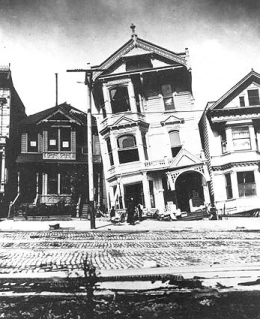
The natural earthquake or shaking that pounds away at the buildings erected by men, exploiting any weakness in their design, is a parable of the divine shaking that is for the express purpose of judging the "things that are made," that only the eternal things, which cannot be shaken, will remain. This on-going judgment of God begins first in the household of God (see1 Peter 4:17).
What is meant by these words "Yet once more I shake"? To what purpose is this shaking? In what way does this serve the divine will? What exactly are those things that are being shaken and removed?
Throughout the previous eleven chapters the author of Hebrews wrote of the coming of a better hope, a better testament, established upon better promises, with better sacrifices, consisting of a better and enduring substance. There is mention of a better country, not of this worldly, temporal kosmos but a heavenly city, built in eternity by divine hands.
We are called to be partakers of a heavenly calling, realized through heavenly gifts. In Christ there has been a great transition from an earthly to a heavenly position, from an earthly Zion to a heavenly Zion, from and earthly Jerusalem to the Jerusalem which is above, the mother of us all. Shifting from earthly sanctuaries, holy sites and sacrifices, with temporal priesthood, ceremonies and services, to the heavenly sanctuary made without hands. (See Hebrews 9:23). Yes! Absolutely nothing in this heavenly realm has been made or defiled by human hands. Neither is anything made by human hands accepted there. The tabernacle of Moses, which was built after "the pattern of things in the heavens," was a picture of good things to come, pointing toward and leading to the reality of the heavenly sanctuary. There we have a great high priest that is passed into the heavens, Jesus the Son of God. (See Hebrews 4:14). Before this could happen, Jesus must first accomplish God's will upon the earth.
The author of Hebrews quoted Jesus as saying, "Behold, I have come to do Your will, O God." Jesus came to do the will of God, but what was it that God wanted Jesus to do? We find the answer in the very same verse. "He takes away the first that He may establish the second" (Hebrews 10:8-9). God first established the pattern of the heavenly in the earthly, as an interim measure, as a representation or testimony of better things to come, as a promise of His intention to lead His people on into all that the earthly pattern signified. In Christ the time of fulfillment has come. The first or earthly pattern (that religious men had become attached to) should be taken out of the way to establish the second or heavenly reality, with an invitation to all to enter into the heavenly sanctuary into God's presence, by Christ's shed blood.
In the verses quoted above, God's will has a twofold emphasis, taking away and establishing. God's will in this matter has not changed. It is ongoing. He is still removing the earthly religious scaffolding so the heavenly reality can be established and fully known. It is in this area that religious man has the greatest difficulty submitting to the will of God. He is hesitant to abandon the earthly and ceremonial and embrace the heavenly reality. Nothing could be more clearly the will of God and yet he refuses to give up the first things to embrace the better things. Man loves earthly things and religious man is driven to create an outward and earthly system of religion, something he can manage, having defined perimeters. He believes that if the pattern is correct life will follow. Sadly though, his handiwork is characteristically introverted and ingrown, having a life of its own, living unto itself, exhibiting a bent toward sectarianism. Clinging to the old religious order, religious man continues to add activity to activity, seeking to find new and exciting programs and amusements to offset the boredom of living beneath his heavenly calling and heritage.
The temple at Jerusalem was destroyed by Titus the Roman Conqueror in 70 A D., exactly as Jesus had foretold, and in the same way, not one stone of the old religious order will survive the divine shaking.
There is ample evidence to conclude that early on in the history of the church there was a large scale return to the shakable things of the old religious order. This was the reason that the book of Hebrews was written. Much of what calls itself Christendom today is the fruit of the same apostasy.
For this reason, God continues to shake the scaffolding of today's "Christian" religion, which is largely founded upon that very compromise. The mounds of rubble and ash strewn over the landscape of Christendom are ample proofs of the frailty and temporality of much that is called "Christian" today. The sound of the collapsing superstructures of religious men can yet be heard at regular intervals amid the intermittent groans of the suffering souls who dared to trust in their strength.
God is doing the shaking! He will not stop until all that is left of the old religious paradigm that obscures His Son is removed from our lives. He will not stop until the first is taken away and the second is established.
Is there nothing sure? Is there nothing beyond the quaking and uncertain realm of this temporal kosmos? Is there no rock, no sure and unshakable foundation? Thank God! It is with great joy that I inform you that all believers are receiving a kingdom that cannot be shaken!
A Kingdom that Cannot be Shaken
Therefore, since we are receiving a kingdom which cannot be shaken, let us have grace, by which we may serve God acceptably with reverence and godly fear. (Hebrews 12:28)
What is this unshakable kingdom? Is it the church? No. The kingdom of God predates the New Testament Church. Nowhere in the scriptures is there an instance where anyone preached "the church." Amazingly the New Testament is devoid of a great deal of emphasis on ecclesiology. But the ekklesia or called out community did have a concise message to declare to the world. They preached Christ and "the kingdom of God." They preached the King and the Kingdom. Their emphasis was on the kingdom, which cannot be shaken, rather than upon themselves as an ecclesiastical body. The kingdom does not come with observation. It is not the visible church. It is a heavenly realm and reality in which the believer and bidden to enter into the presence of God, in the heavenly sanctuary. Ours is a heavenly calling (Hebrews 3:1) by which we are seated in heavenly places in Christ Jesus (Ephesians 1:3, 2:6). Therefore, Paul exhorted the Colossian believers to "seek the things that are above, where Christ is, seated on the right hand of God" (Colossians 3:1).
This preoccupation with Church, rather than the Kingdom, has led to a disorder, which I have chosen to call "churchiness." Churchiness does to an assembly of believers what selfishness does to an individual. It causes an assembly to turn inward and focus solely on themselves. As a result, Christ, the believers, and a dying world are neglected as men spend their lives in service to an institution called "the Church." Instead of the commission to go into the entire world and preach the gospel, there is the mandate to invite them to come to church and fill the empty pews.
This inordinate devotion to an institution is, I believe, the primary reason for most of the suffering of the believers today. It puts you on shaky ground. I am not discrediting a wholesome dedication to the family of God, laying down our lives for each other, but the inordinate obsession with ecclesiastical systems. Church centeredness is not necessarily Christ centeredness or kingdom centeredness. Christ instructed His disciples to seek the kingdom, not the church. When we seek the church or our focus is purely upon the church or some model of church we will most certainly miss the eternal thing and build again what God has taken away in Christ. Remember Paul's words to Peter, who was tempted to return to the tenets of Judaism, especially as it applied to separation from the Gentiles, "For if I build again the things which I destroyed, I make myself a transgressor" (Galatians 2:18). Likewise, if we build again what God has abolished we also make ourselves transgressors.
In his excellent article entitled "Breakout," Alan Richardson points out how easily we miss the kingdom when we seek the church.
"If you seek church, you will lose The Kingdom. And I'm not talking here about our inheritance in eternity, but the possession which God has given us to bring to the earth in this life. Church as an agenda or a goal clouds and confuses the simplicity of that purpose and the goal which we are (still) here on earth for. "Church" - when it is our agenda - becomes a third Kingdom, a kingdom which hinders the perspective and penetration of one Kingdom (the Kingdom of God) and with its self interests and agenda of self preservation, unwittingly serves the Kingdom we are called to withstand - The Kingdom of this world."
A lesson from history may serve us well, because as is so often the case history repeats itself. Judaism of the first century had also become an entity unto itself, no longer living solely for God's glory. Instead their motives sprang from a desire to propagate their own uniqueness and to protect their religious identity, even if that meant killing God's Son. They refused to accept God's will and allow these things to be taken out of the way so Jesus could be all and in all. This is why Paul referred to the Judaizers (Jewish believers who refused to let go of the tenets of Judaism) as "the enemies of the cross." Jesus was a threat to them just as He was to the Scribes and Pharisees, and for the same reasons, He remains a threat to the religious systems of men to this very day.
Most of the early Jewish believers came out of Judaism, unto Jesus outside the camp, bearing His reproach, suffering the scorn of the orthodox religious system of their day. However, many devout Jews considered this radical departure from the orthodox norm to be extreme. For this reason many of them kept what they considered to be the indispensable tenets of Judaism, such as circumcision and law keeping. In doing so they avoided the suffering of the cross and became the enemies of the cross. In fact, Paul acknowledged that all he need do to be free of persecution was to simply add the preaching of circumcision to his gospel message (Galatians 5:11). Then the offense of the cross would cease. The temptation to compromise and cling to the old religious order is Satan's most effective means of rendering the believer and the ekklesia powerless. Much that we see in Christendom today is the fruit of this compromise.
Our God is a Consuming Fire
Here the author of Hebrews changes the illustration from an earthquake to a raging or consuming fire.
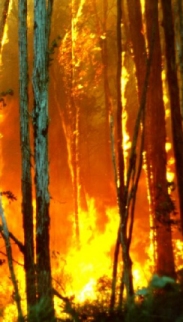
I live in a mountainous area in Idaho. Dependent upon the conditions, the fires in the mountains, often caused by lighting strikes, can be quite destructive. One of the worst was the fire of 1910. It consumed one-sixth of Idaho's northern forests, greatly changing the landscape of our state, leaving in its aftermath the baked soil and charged stems of trees that only days before towered over the lush forest floor.
This is the picture that the author of Hebrews is setting forth, a trial by fire in which only those things that are of eternal value can endure.
In 1 Corinthians 3:11-17 Paul tells of this consuming fire.
For no one can lay any other foundation than that which has been laid, which is Jesus Christ. But if anyone builds on the foundation with gold, silver, costly stones, wood, hay, or stubble; each man's work will be revealed. For the Day will declare it, because it is revealed in fire; and the fire itself will test what sort of work each man's work is. If any man's work remains which he built on it, he will receive a reward. If any man's work is burned, he will suffer loss, but he himself will be saved, but as through fire. Don't you know that you are a temple of God, and that God's Spirit lives in you? If anyone destroys the temple of God, God will destroy him; for God's temple is holy, which you are.
God is still shaking and trying by fire. All that does not have His glory at heart, all that is earthly and refuses to be conformed to His Son, will be brought to desolation and lie like the smoldering ruins of San Francisco, as so much waste to be removed before anything eternal can be established. God is intent on removing the first things of the first religious order, which had value only for a season, as a testimony of good things to come. Hear me, dear reader! Those Good Things have come and they are realized only in Christ. The Substance is Christ!
Jesus Christ is the standard by which the Father judges all things. Christ is the foundation, the Rock, the only solid and immovable ground. Those things that are not built upon His work and person cannot withstand the shaking which will intensify in the days to come. Our God is a consuming fire. He is burning away the wood, hay and stubble of man's religion, which stands in defiance of Christ's finished work. Like the Judaizers, religious men insist on keeping much of the old religious order, arguing with God who is taking away the first to establish the second. Nothing of the old religious order that men ignorantly built on the Foundation, which is Christ, will remain. "The day will declare it." God has spoken and is yet speaking! "Yet once more I shake . . . that the things which cannot be shaken may remain."
to top