



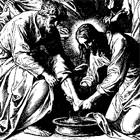
On the other end of the spectrum is the kingdom of God. Jesus told His disciples that the kosmos system (translated "world" in the New Testament) was not to be emulated among them, and then He did a remarkable thing. He led by example, doing the opposite of the world. He stripped Himself of His clothes, wrapped Himself in a servant's towel and washed their feet! He never took up an offering, nor did He command a wage. He had no house, much less a mansion. He walked almost everywhere He went--no corporate limos or jets. Consider what He taught the disciples by His actions and in His words:
But Jesus called them to him and said, "You know that the rulers of the Gentiles lord it over them, and their great men exercise authority over them. It shall not be so among you; but whoever would be great among you must be your servant, and whoever would be first among you must be your slave; even as the Son of man came not to be served but to serve, and to give his life as a ransom for many." (Matthew 20:25-28 RSVA)
And he said to them, "The kings of the Gentiles exercise lordship over them; and those in authority over them are called benefactors. But not so with you; rather let the greatest among you become as the youngest, and the leader as one who serves. For which is the greater, one who sits at table, or one who serves? Is it not the one who sits at table? But I am among you as one who serves. (Luke 22:25-27 RSVA)
Jesus, knowing that the Father had given all things into his hands, and that he had come from God and was going to God, rose from supper, laid aside his garments, and girded himself with a towel. Then he poured water into a basin, and began to wash the disciples' feet, and to wipe them with the towel with which he was girded. He came to Simon Peter; and Peter said to him, "Lord, do you wash my feet?" Jesus answered him, "What I am doing you do not know now, but afterward you will understand." (John 13:3-7 RSVA)
In each of these passages Jesus is either speaking of Himself as a lowly servant or is serving them in the lowest place. He is not only talking about serving, but He actually did serve. He also taught the disciples to serve those around them just as He did. Paul also taught that this Servant Christ is our example to follow.
Have this mind among yourselves, which is yours in Christ Jesus, who, though he was in the form of God, did not count equality with God a thing to be grasped, but emptied himself, taking the form of a servant, being born in the likeness of men. And being found in human form he humbled himself and became obedient unto death, even death on a cross. (Philippians 2:5-8 RSVA)
When the early church in the book of Acts was overflowing with new converts to Christ, there were some among them that were needy. The apostles took up a collection that was laid at their feet, not put into their money bags if they even had any (see Acts 3:3-7). It was there for any who had need and the result was that "no one said what they had was their own" and "no one was lacking." Collecting money was about meeting the needs of the widows and orphans and the strangers in their gates who came to Christ, not supplying the leaders with a salary or starting a building fund as it is today. They taught that the church, the elect of God, are His temple and the saints literally brought their offerings into that same temple and His house (household) was full.
Jesus told the disciples, "Freely you have received, freely give." This principle is all through the scriptures once you let the Lord show it to you and are no longer blinded by the traditions of today's false church leadership. Too many are into "ministry" for gain or to be served. Paul himself was a servant at all times even unto his death. The verses below show how he not only did not demand support money from the churches (being served by them), but he worked day and night among them so he could provide for their needs. If you look for this example in today's steeple houses you will be hard pressed to find it.
Please consider how God feels about this in Paul's instructions to the elders of the church at Ephesus.
For I know this, that after my departing shall grievous wolves enter in among you, not sparing the flock. Also of your own selves shall men arise, speaking perverse things, to draw away disciples after them. Therefore watch, and remember, that by the space of three years I ceased not to warn everyone night and day with tears... I have coveted no man's silver, or gold, or apparel. Yea, you yourselves know, that these hands have ministered unto my necessities, and to them that were with me. I have showed you all things, how that so laboring you ought to support the weak, and to remember the words of the Lord Jesus, how he said, It is more blessed to give than to receive. (Acts 20:29-35 KJ2000)
When Paul wrote to the Corinthians he was very emphatic about his stand concerning the asking for donations as being an affront to the preaching of the gospel.
If we have sown unto you spiritual things, is it a great thing if we shall reap your material things? If others be partakers of this right over you, are not we rather? Nevertheless we have not used this right; but endure all things, lest we should hinder the gospel of Christ... But I have used none of these things: neither have I written these things, that it should be so done unto me: for it were better for me to die, than that any man should make my boasting void. (1 Corinthians 9:11-15 KJ2000)
Paul said it would better to die than hinder the gospel by begging for support. He continues in his letters to the Corinthian church:
What is my reward then? Verily that, when I preach the gospel, I may make the gospel of Christ without charge, that I abuse not my right in the gospel. For though I am free from all men, yet have I made myself servant unto all, that I might gain the more. (1 Corinthians 9:18-19 KJ2000)
Even as I please all men in all things, not seeking my own profit, but the profit of many, that they may be saved. (1 Corinthians 10:33 KJ2000)
Receive us; we have wronged no man, we have corrupted no man, we have defrauded no man. (2 Corinthians 7:2 KJ2000)
And when I was present with you, and in want, I was chargeable to no man: for that which was lacking to me the brethren who came from Macedonia supplied: and in all things I have kept myself from being burdensome unto you, and so will I keep myself. (2 Corinthians 11:9 KJ2000)
Here for the third time I am ready to come to you. And I will not be a burden, for I seek not what is yours but you; for children ought not to lay up for their parents, but parents for their children. I will most gladly spend and be spent for your souls. If I love you the more, am I to be loved the less? (2 Corinthians 12:14-15 RSVA)
So, was this an attitude of life and his service to the saints in Corinth only, as some insist? Consider the tenderness for Paul's heart toward the church of Thessalonica. He didn't want to be burdensome to them either.
For neither at any time used we flattering words, as you know, nor a cloak of covetousness; God is witness: Nor of men sought we glory, neither of you, nor yet of others, when we might have been burdensome, as the apostles of Christ. But we were gentle among you, even as a nurse cherishes her children: So being affectionately desirous of you, we were willing to have imparted unto you, not the gospel of God only, but also our own souls, because you were dear unto us. For you remember, brethren, our labor and travail: for laboring night and day, because we would not be a burden unto any of you, we preached unto you the gospel of God. (1 Thessalonians 2:5-9 KJ2000)
Supporting himself by day and teaching the saints in Thessalonica by night, Paul was the abject servant of all men and Christ. Did he do this as a commandment that only he followed or was this to be an example to all the saints? Read on:
"For you yourselves know how you ought to follow us: for we behaved not ourselves disorderly among you; Neither did we eat any man's bread for nothing; but worked with labor and travail night and day, that we might not be a burden to any of you: Not because we have not that right, but to make ourselves an example unto you to follow us. For even when we were with you, this we commanded you, that if any would not work, neither should he eat" (2 Thessalonians 3:7-10 KJ2000).
And what was Peter's council to the elders of the church?
Tend the flock of God that is your charge, not by constraint but willingly, not for shameful gain but eagerly, not as domineering over those in your charge but being examples to the flock. (1 Peter 5:2-3 RSVA)
How about John the apostle whom Jesus loved? What was the example of true servants among the saints that he sent out?
Beloved, you do faithfully whatsoever you do for the brethren, and for strangers; Who have borne witness of your love before the church: whom if you send forward on their journey in a godly manner, you shall do well: Because for his name's sake they went forth, taking nothing of the Gentiles. We therefore ought to receive such, that we might be fellow helpers to the truth. (3 John 1:5-8 KJ2000)
Paul refers to taking support from the churches as being burdensome to them and refuses to do it except for what He got from the Macedonians, and he called that robbery. He was the utmost servant who lived after the pattern of Christ, the servant of all. Even Peter and John spoke of the free giving of service to the saints, not seeking anything in return.
Isaiah warned of the excess we see today as so-called "ministers" beg for money and use their positions for the purpose of getting gain. He wasn't very nice about it, either, calling them greedy dogs!
For Israel's watchmen are blind, the whole lot of them. They have no idea what's going on. They're dogs without sense enough to bark, lazy dogs, dreaming in the sun-- But hungry dogs, they do know how to eat, voracious dogs, with never enough. And these are Israel's shepherds! They know nothing, understand nothing. They all look after themselves, grabbing whatever's not nailed down. (Isaiah 56:10-11 MSG)
The prophet Micah also spoke for God concerning this sin of prophets seeking their own.
Thus says the LORD: Concerning the prophets who make my people stray, who bite with their teeth, and cry, Peace; and he that puts nothing into their mouths, they even prepare war against him. (Micah 3:5 KJ2000)
And regarding the rest of Israel's corrupt leadership, Micah continues:
Hear this, I pray you, you heads of the house of Jacob, and rulers of the house of Israel, that abhor justice, and pervert all equity. They build up Zion with blood, and Jerusalem with iniquity. Her heads judge for reward, and her priests teach for hire, and her prophets divine for money: yet will they lean upon the LORD, and say, Is not the LORD among us? no evil can come upon us. (Micah 3:9-11 KJ2000)
Sound familiar? It should! Whenever I have seen a dispute between two families in a church come before the pastor, the one that put the most money in the church coffers always won. Pastor-teachers (equivalent to Old Testament priests) on salary are common place these days, but it was not so in the early church. Prophetic conferences where an attendee can get a special "personal prophesy" for a donation is becoming the norm. The attitude is, "Everybody is doing it. God must be pleased!"
These are only some of the verses that I have found where the Bible speaks out against charging for service to God's elect or for preaching the gospel. You will not hear these verses preached from the pulpit unless it is a portion that is preached out of context like, "It is more blessed to give than to receive," which was written to the elders of the churches that they would give to the needs of the people!
Yes, the laborer is worthy of his hire, but when these "laborers" are so focused on their wages, they seem to do a poor job of what they have been "hired" to do. Mammon soon becomes the major concern, not serving Jesus and His church. The heart of God is on giving, not getting, and on serving, not being served. If the ox harnessed to the mill that grinds out the corn ate all the farmer's profits as we see today, he would soon be part of an old fashioned barbeque! The farmer (in this analogy, God) could not afford his services for long.
George Mueller founded many orphanages in England and he staked everything upon one great experiment-- he had set himself to prove that the prayer which resorts to God only will bring help in every crisis, even when the crisis is unknown to His people whom He uses as the means of relief and help.
One time there remained in hand but twenty-seven pence ha'penny to meet the needs of hundreds of orphans. Nevertheless this was the reply to a letter asking if he had any needs:
Whilst I thank you for your love, and whilst I agree with you that, in general, there is a difference between asking for money and answering when asked, nevertheless, in our case, I feel not at liberty to speak about the state of our funds, as the primary object of the work in my hands is to lead those who are weak in faith to see that there is reality in dealing with God alone.
Consistent with his position, however, no sooner was the answer posted than the appeal went up to the Living God:
Lord, thou knowest that, for Thy sake, I did not tell this brother about our need. Now, Lord, show afresh that there is reality in speaking to Thee only, about our need, and speak therefore to this brother so that he may help us.
In answer, God moved this inquiring brother to donate one hundred pounds, which came when not one penny was in hand." (Trials of Faith, and Helpers to Faith, chapter 11)
"The LORD shall open unto thee his good treasure, the heaven to give the rain unto thy land in his season, and to bless all the work of thine hand: and thou shalt lend unto many nations, and thou shalt not borrow." (Deuteronomy 28:12)
"And I will make them and the places round about my hill a blessing; and I will cause the shower to come down in his season; there shall be showers of blessing." (Ezekiel 34:26)
George Mueller counted all as loss that men count gain, but it was for the excellency of the knowledge of Jesus, his Lord. He suffered the loss of all things and counted them as dung, but it was that he might win Christ and be found in Him; that he might know Him, and not only the fellowship of His sufferings and conformity to His death, but the power of His resurrection, conformity to His life, and fellowship in His glory. He left all behind that the world values, but he reached forth and pressed forward toward the goal, for the prize of the high calling of God in Christ Jesus.
"For God so loved the world, that he gave his only begotten Son," requiring nothing in return but faith in Him alone. Go ye and do likewise.
to top